The Twelfth Unboxing: Keeping UK Subscription Packaging Fresh Beyond the First Delivery
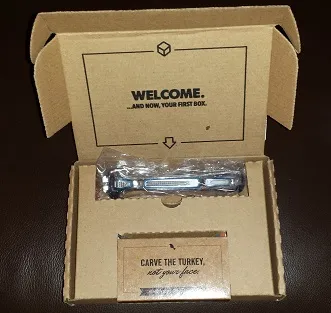
Photo: Whoisjohngalt, CC BY-SA 3.0, via Wikimedia Commons
Subscription commerce rewards retention rather than acquisition. The first parcel has to persuade a customer that the decision was sound; the second, third and twelfth have to persuade them that the decision remains sound. For UK subscription brands, packaging therefore has a dual role. It must be stable enough to control costs, meet producer responsibility expectations and fit existing fulfilment lines. It must also feel fresh enough that the monthly arrival does not become background noise.
The solution is rarely a completely new box every month. It is more often a disciplined system: a fixed structural core, a small number of variable elements and a calendar that makes change feel intentional rather than improvised.
Design the chassis once, vary the surface
A subscription pack benefits from a stable chassis. This is the outer box, mailer or bag that has been tested for transit, sized for volumetric efficiency and specified in a material that can be recycled through ordinary UK household collections. Standardising this element reduces tooling costs, simplifies storage and makes it easier to meet packaging data obligations as UK packaging EPR arrangements continue to bed in.
Freshness can then be introduced through the surface rather than the structure. A printed belly band, a lid label, a paper wrap or a single-colour overprint can change the pack’s mood without changing its dimensions. For a coffee subscription, the variation might be a roast profile band in a different colour. For a pet supplement service, it might be a seasonal illustration on the outer wrap. For a stationery club, it could be a numbered edition mark that gives the parcel a sense of sequence.
This approach also protects fulfilment speed. Pickers are not learning a new pack format each month, and the outer case still stacks predictably in a small warehouse. The customer sees change; the operation sees continuity.
Inserts that earn their place
Modular inserts are the most practical way to make repeat unboxings feel tailored. A pulp tray, a folded paperboard fitment or a corrugated divider can be designed once and used across several product variants. When the contents change, the insert changes only where it needs to. The outer box remains the same.
There is a sustainability argument here as well as a cost one. A well-designed insert replaces loose void fill, reduces movement in transit and can be made from the same fibre stream as the outer box. That makes the pack easier to explain to customers and easier to recycle at kerbside. Mixed-material inserts, by contrast, tend to undermine the simple message that many UK subscribers want: separate paper from plastic, then recycle the paper.
For low-volume subscription brands, the smart move is to limit the number of insert SKUs. Two or three fitments may cover a year of product rotations if the design allows for slight size variation. A generous tolerance in the fitment is often more useful than a perfectly snug tray that only works for one item.
Seasonal overprints without seasonal waste
Seasonal packaging can easily become a trap. A Christmas box ordered in September may look stale by January, and a spring design may still be sitting in the warehouse when summer promotions begin. Subscription brands need seasonal variation that can be applied late, stored flat and used across more than one occasion.
Digital overprinting on a standard outer is one route. So is a seasonal paper band, a sticker applied at packing or a printed card that sits inside a neutral envelope. These methods allow smaller runs than a full custom box and reduce the risk of committing to a design that dates quickly.
It is worth planning the year in quarters rather than months. A winter palette can cover November to February; a fresh spring treatment can run from March to May. This reduces the number of design changes while still giving subscribers a visible signal that the service is paying attention. The result is not novelty for its own sake, but a rhythm that feels deliberate.
A ritual, not a gimmick
Repeat unboxing depends on familiarity as much as surprise. Subscribers often look forward to the same small sequence: the outer wrap, the welcome card, the product bundle, the note explaining the month’s selection. That sequence is a ritual, and rituals are strengthened by consistency.
Brands can vary the content of the ritual without disrupting its shape. A fixed card size, a consistent opening tab and a standard position for the product story create recognition. The monthly change can then happen in the copy, the colour or the featured item. This is particularly useful for UK brands serving customers who receive several subscription parcels each month and rely on quick visual cues to tell one delivery from another.
Customisation should stop before it becomes clutter. If every parcel contains a new leaflet, a new sticker and a new insert, the customer may notice effort but not coherence. A smaller number of well-chosen changes tends to read as more premium than a pack that tries to do too much.
The recyclability test
Subscription packaging is opened in the home, often in front of the person who will decide whether to renew. That makes end-of-life clarity a branding issue, not just a compliance one. A pack that separates easily into paper and plastic, with clear on-pack recycling information, supports the service’s sustainability claims and reduces customer confusion.
In practice, this favours fibre-based outer packaging, paper bands and paper-based inserts where performance allows. Where a barrier layer is necessary, it should be justified by the product and explained simply. Water-based inks and minimal laminates help keep the fibre stream cleaner. The objective is not to claim perfection, but to make the responsible disposal route obvious and consistent from one delivery to the next.
Low-volume customisation in practice
Customisation at low volume has limits. Print minimums, lead times and storage space all shape what is realistic. A subscription brand sending 300 parcels a month cannot behave like a retailer ordering 30,000 boxes. The practical answer is to customise the elements that are cheap to change and standardise the elements that are expensive to change.
That may mean one outer box, two insert formats, four seasonal bands and a monthly card. It is a modest kit, but it can produce a year of variation without a warehouse full of obsolete packaging. For UK subscription businesses in 2026, that discipline is likely to matter more than ever: customers expect freshness, regulators expect data and recyclability, and margins expect restraint. The twelfth unboxing should feel new, but the system behind it should feel calm.